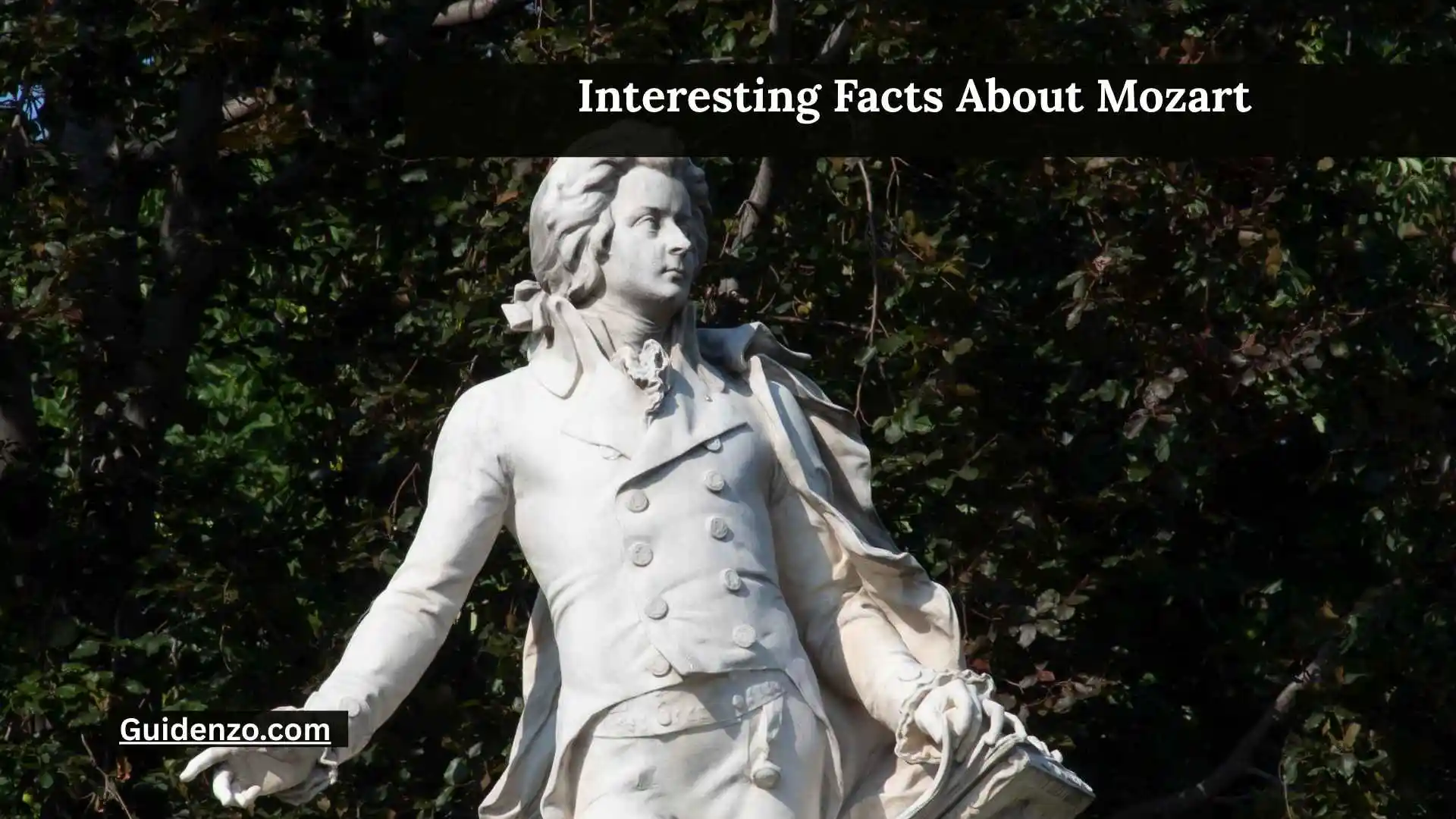
Wolfgang Amadeus Mozart remains one of history’s most astonishing creative minds. Born into a world of powdered wigs and candlelit courts, he produced music of unmatched clarity, emotion, and invention before dying at just 35. His life mixed dazzling talent with ordinary human struggles—travel, family pressures, financial ups and downs, and a sharp sense of humor that rarely appears in the polished portraits. These interesting facts about Mozart go beyond the familiar child-prodigy stories.
They show how a boy from Salzburg absorbed the musical languages of Europe, transformed them, and left works that still shape concert halls, opera houses, and even popular culture more than two centuries later. Readers will discover the man behind the myth: the composer who transcribed forbidden music from memory, kept a starling as a pet, collaborated with a former Venetian pimp, and wrote some of his greatest masterpieces while facing illness and debt.
Quick Answer
Wolfgang Amadeus Mozart (1756–1791) was a Salzburg-born composer of the Classical era who wrote more than 600 works, including operas such as The Marriage of Figaro and The Magic Flute, 41 symphonies, and 27 piano concertos. A child prodigy who performed across Europe by age six, he combined extraordinary memory, speed of composition, and emotional depth. He died in Vienna at 35, leaving an unfinished Requiem that still captivates audiences worldwide.
Quick Facts Table
| Field | Detail |
| Full Baptismal Name | Johannes Chrysostomus Wolfgangus Theophilus Mozart |
| Born | January 27, 1756, Salzburg |
| Died | December 5, 1791, Vienna (age 35) |
| Father | Leopold Mozart (violinist, composer, teacher) |
| Mother | Anna Maria Pertl |
| Spouse | Constanze Weber (married 1782) |
| Surviving Children | Two sons (Karl Thomas and Franz Xaver Wolfgang) |
| Catalog System | Köchel (K.) numbers |
| Estimated Output | Over 600 works |
| Fun Fact | Owned a starling that sang one of his themes |
Main Interesting Facts
1. His Full Name Was a Multilingual Mouthful
Mozart was baptized Johannes Chrysostomus Wolfgangus Theophilus Mozart. “Theophilus” means “lover of God” in Greek; he freely translated it as Amadeus (Latin), Amadé (French), or Gottlieb (German) depending on the country and mood. He rarely used “Amadeus” himself; that form became standard only after his death. The variety shows how fluid identity and language were for a traveling musician in the Holy Roman Empire. Understanding his name choices reveals a practical, adaptable mind rather than a fixed romantic image.
Did You Know? In Italy he sometimes signed letters Wolfgango Amadeo.
2. He Began Composing Before Most Children Learn to Read Fluently
By age five Mozart was writing short keyboard pieces that his father carefully preserved. Leopold noted that the boy composed an Andante and Allegros in the months after his fifth birthday. These early works already show a sense of balance and melody rare in any child. The surviving pieces demonstrate that prodigious talent combined with rigorous daily practice under a skilled teacher. His early output proves that genius can appear extremely young when environment and ability align.
Did You Know? His sister Nannerl’s music notebook contains some of the first written evidence of his compositions.
3. The Family Spent Nearly a Decade on the Road
Between 1762 and 1766 the Mozart children performed in dozens of European cities, including Munich, Vienna, Paris, and London. Leopold calculated that Wolfgang spent roughly 3,720 days of his short life traveling. The tours exposed him to every major musical style of the day and to the courts that controlled patronage. Constant movement also meant repeated illness—smallpox, rheumatic fever, and other infections left lasting marks. The experience forged both his cosmopolitan musical language and his lifelong restlessness.
Did You Know? The family once spent 15 months in London, where the eight-year-old wrote his first symphony.
4. He Transcribed Allegri’s Miserere From a Single Hearing
In Rome in 1770 the 14-year-old Mozart heard Gregorio Allegri’s Miserere in the Sistine Chapel. The work was closely guarded by the Vatican and not allowed to be copied. Mozart wrote the entire complex score from memory afterward, later returning to check accuracy. The feat astonished contemporaries and earned him recognition from the Pope. It remains one of the clearest demonstrations of his near-perfect musical memory and absolute pitch.
Did You Know? The Pope later made him a Knight of the Order of the Golden Spur.
5. He Proposed Marriage to a Future Queen of France
As a child performing at Schönbrunn Palace, young Mozart slipped on a polished floor. Archduchess Marie Antoinette (then about the same age) helped him up. In gratitude he reportedly proposed marriage. The story, whether fully accurate or polished by family lore, captures the ease with which the child moved among royalty. It also hints at the social ambitions Leopold cultivated for his son. The encounter later became a colorful anecdote in biographies.
Did You Know? Marie Antoinette was two months older than Mozart.
6. Empress Maria Theresa Called Him “Useless”

When Archduke Ferdinand considered hiring the young Mozart, his mother Empress Maria Theresa vetoed the idea, describing such people as “useless.” The remark reflected court attitudes toward freelance musicians more than any judgment of talent. Mozart never secured a long-term high-status court post despite his gifts. The episode illustrates the precarious social position of even the most celebrated composers of the era.
Did You Know? The same empress had earlier received the Mozart children warmly at court.
7. He Wrote His First Opera at Eleven
Apollo et Hyacinthus (1767) was composed when Mozart was only eleven. The Latin intermezzo already shows dramatic sense and skillful handling of voices. It was performed at the University of Salzburg. Early operatic experience prepared him for the mature masterpieces of the 1780s. The work demonstrates how rapidly he absorbed the Italian operatic tradition.
Did You Know? He went on to write more than twenty stage works of various kinds.
8. A Starling Became His Musical Companion
On May 27, 1784, Mozart bought a starling in a Vienna pet shop. The bird could whistle a theme from his Piano Concerto No. 17 in G major. He recorded the purchase in his expense book and later wrote a humorous elegy when the bird died. The episode reveals a playful domestic side often missing from grand narratives. The starling’s mimicry also shows how closely Mozart’s music entered everyday Viennese life.
Did You Know? He held a formal funeral for the bird complete with processional and poem.
9. His Letters Are Full of Scatological Humor
Private correspondence with his cousin and others contains elaborate toilet jokes and wordplay that shock modern readers. Such humor was common in middle-class German-speaking circles of the time. The letters humanize a figure often treated as ethereal. They also show a mind that delighted in language games as much as musical ones. Modern speculation about Tourette’s syndrome lacks firm evidence; the jokes more likely reflect period taste and high spirits.
Did You Know? He once wrote an entire letter in the form of a comic poem about bodily functions.
10. He Collaborated With a Former Venetian Pimp
Librettist Lorenzo Da Ponte had been banished from Venice after running a brothel and related scandals. In Vienna the two men created three of the greatest operas in the repertory: The Marriage of Figaro, Don Giovanni, and Così fan tutte. Their partnership combined Da Ponte’s theatrical flair with Mozart’s psychological insight. The collaboration proves that artistic excellence can arise from unlikely alliances.
Did You Know? Da Ponte later emigrated to America and taught Italian at Columbia College.
11. He Dedicated Six String Quartets to Haydn
Mozart deeply admired Joseph Haydn and called him “Papa Haydn.” In 1785 he dedicated a set of six quartets (K. 387, 421, 428, 458, 464, 465) to the older composer. Haydn told Leopold that Mozart was “the greatest composer known to me.” The works absorb Haydn’s innovations while adding new emotional depth. The friendship shows mutual respect across a generation gap of 24 years.
Did You Know? Haydn and Mozart played chamber music together in private.
12. Only Two of His Six Children Survived Infancy
Mozart and Constanze had six children; four died in infancy or early childhood, a tragic but common pattern in the 18th century. The two survivors were Karl Thomas and Franz Xaver Wolfgang. High infant mortality shaped family life and emotional resilience. Constanze’s later efforts to preserve her husband’s legacy became crucial for posterity. The losses add a human dimension to the story of creative abundance.
Did You Know? Franz Xaver Wolfgang later pursued a modest career as a composer and pianist.
13. He Composed the Final Three Symphonies in Six Weeks
In the summer of 1788 Mozart wrote Symphonies Nos. 39, 40, and 41 (the Jupiter). These works represent the summit of Classical symphonic writing. No evidence shows they were commissioned; he may have written them for projected concerts that never materialized. The speed and quality illustrate his ability to work under pressure while maintaining the highest standards. The Jupiter finale remains a model of contrapuntal mastery.
Did You Know? Symphony No. 40 in G minor is one of only two minor-key symphonies he completed.
14. The Requiem Was Commissioned Anonymously
Count Franz von Walsegg ordered the Requiem through intermediaries, intending to pass it off as his own composition for his late wife. Mozart worked on it during his final illness. After his death, student Franz Xaver Süssmayr completed the score from sketches and instructions. The mystery surrounding the commission fueled later romantic legends. The finished work still stands as one of the most powerful settings of the Mass for the Dead.
Did You Know? The opening Introit and Kyrie are entirely Mozart’s.
15. He Joined a Masonic Lodge
In 1784 Mozart became a Freemason in the Viennese lodge “Zur Wohltätigkeit.” Masonic ideals of brotherhood and enlightenment appear in several works, most famously The Magic Flute. The opera’s structure uses the number three repeatedly—three ladies, three boys, three trials. Membership connected him to progressive intellectual circles in Vienna. His Masonic music remains among the most beautiful ceremonial pieces of the era.
Did You Know? He composed several shorter Masonic cantatas and songs as well.
16. Smallpox Left Permanent Scars
During the family’s travels Mozart contracted smallpox, which marked his face. Contemporary descriptions note he was small, thin, and pale, with a large head of fine fair hair of which he was vain. Physical appearance mattered little beside his talent, yet the scars remind us of the medical realities of the age. Surviving such illnesses was itself an achievement. The episode underscores the fragility of even the most gifted lives.
Did You Know? Several siblings had already died in infancy before Wolfgang’s birth.
17. He Could Compose Entire Works in His Head
Contemporaries reported that Mozart often worked out complete movements mentally before writing them down with few corrections. Surviving autographs show remarkably clean scores. This ability allowed him to produce music rapidly while traveling or under deadline. It also explains how he could finish major works so close to premiere dates. The mental fluency remains one of the most impressive aspects of his genius.
Did You Know? He sometimes wrote letters and composed music simultaneously.
18. Beethoven Sought Lessons From Him
In 1787 the 16-year-old Beethoven traveled to Vienna hoping to study with Mozart. Accounts differ on how much contact occurred, but the visit shows Mozart’s reputation among the next generation. Beethoven later expanded many of the forms Mozart had perfected. The brief overlap of the two careers marks a pivotal moment in musical history. Mozart’s influence on Beethoven is audible in early piano concertos and chamber works.
Did You Know? Mozart’s death prevented any extended teacher-student relationship.
19. He Popularized the Piano Concerto as a Public Genre
Mozart transformed the piano concerto from a courtly entertainment into a vehicle for personal expression and virtuoso display. His 27 concertos explore every emotional shade while maintaining Classical balance. He often performed the solo parts himself. These works remain central to the modern concert repertoire. They also helped establish the piano as the dominant keyboard instrument.
Did You Know? Several concertos include his own cadenzas written out in the scores.
20. Financial Instability Followed Him Throughout Adulthood
Despite high fees for some commissions and teaching, Mozart frequently lived beyond his means. He bought an expensive fortepiano and a billiard table during a prosperous period, then faced mounting debts. Vienna’s shifting musical market and the lack of a stable court salary contributed. Constanze later worked hard to secure a pension and sell manuscripts. The contrast between artistic success and money troubles is a recurring theme in his letters.
Did You Know? Emperor Joseph II eventually gave him a modest court appointment for dance music.
21. His Sister Nannerl Was Also a Remarkable Musician
Maria Anna (“Nannerl”) was an accomplished keyboard player who performed with her brother on the early tours. Social norms of the time limited her public career after adolescence. She later married and preserved family letters and notebooks that remain vital historical sources. Her talent reminds us that the Mozart household contained more than one gifted child. Leopold’s focus gradually shifted to Wolfgang as the more viable professional prospect.
Did You Know? Nannerl outlived her brother by nearly 38 years.
22. He Wrote Music for Almost Every Genre of His Day
Mozart composed operas, symphonies, concertos, chamber music, sacred works, songs, dances, and more. Few composers have matched this range at such a consistently high level. The versatility came from constant exposure to different national styles during his travels. It also reflected the practical demands of earning a living. His output forms a nearly complete map of late-18th-century musical life.
Did You Know? The Köchel catalog organizes the works roughly chronologically.
23. The Magic Flute Premiered Only Two Months Before His Death
Die Zauberflöte opened on September 30, 1791, at a suburban theater run by Emanuel Schikaneder. The opera mixed popular entertainment with Masonic symbolism and profound human themes. It was an immediate success and remains one of the most performed operas worldwide. Mozart conducted some early performances while already ill. The work shows his ability to write for both connoisseurs and broader audiences.
Did You Know? The overture contains three solemn chords that signal Masonic associations.
24. Cause of Death Remains Uncertain
The official record listed “severe miliary fever.” Modern scholars have proposed rheumatic fever, kidney disease, streptococcal infection, and other possibilities. Poisoning by Salieri has been thoroughly debunked. Medical knowledge of the time and the absence of an autopsy leave the question open. What is clear is that he worked almost until the end, dictating parts of the Requiem from his bed.
Did You Know? More than 100 different causes have been suggested over the centuries.
25. He Was Buried in a Standard Simple Grave
Contrary to romantic legend, Mozart received a normal middle-class burial in an unmarked grave, common practice in Vienna at the time to conserve space. Friends and patrons arranged the funeral. Later searches for the exact site proved unsuccessful. The myth of a pauper’s grave grew from 19th-century storytelling. Understanding the actual burial customs restores historical proportion to the final chapter of his life.
Did You Know? Constanze and patron Gottfried van Swieten helped cover expenses.
26. Absolute Pitch and Perfect Memory Were Documented Early
From childhood Mozart could identify any pitch and reproduce complex music after a single hearing. Tests at courts included playing with the keyboard covered by a cloth. These abilities, combined with relentless practice, produced the speed and accuracy of his mature output. Modern research on absolute pitch confirms it is rare and often appears early. In Mozart the trait reached an extreme that still fascinates cognitive scientists.
Did You Know? He could also improvise elaborately on given themes.
27. He Met Johann Christian Bach in London
During the family’s London stay the young Mozart befriended Johann Christian Bach, youngest son of J.S. Bach. The older composer’s galant style influenced Mozart’s early symphonies and keyboard writing. The personal kindness Bach showed the boy left a lasting impression. Cross-generational contacts like this accelerated Mozart’s development. The meeting illustrates how musical ideas traveled through personal relationships as much as through scores.
Did You Know? Mozart later arranged some of J.C. Bach’s sonatas as concertos.
28. His Mother Died While Accompanying Him to Paris
In 1778 Anna Maria Mozart died of illness in Paris while traveling with her son. Wolfgang delayed telling his father the full news, asking a friend to break it instead. Leopold later blamed the trip for her death. The episode strained the father-son relationship. It also left the 22-year-old alone in a foreign city during a difficult professional period.
Did You Know? Mozart was composing the “Paris” Symphony around the same time.
29. He Broke With the Archbishop of Salzburg
Frustrated by restrictive duties and low pay under Archbishop Colloredo, Mozart resigned in 1781 after a heated confrontation. He moved permanently to Vienna to pursue freelance work. The decision was risky but opened the most productive decade of his life. It marks one of the early examples of a major composer choosing independence over secure court service. The break freed him to write the great operas and concertos of the 1780s.
Did You Know? He was literally kicked out of the archbishop’s residence by a court official.
30. The Köchel Catalog Still Organizes His Works
In the 19th century Ludwig von Köchel created a chronological thematic catalog of Mozart’s compositions. Although later revised, the K. numbers remain the standard way to identify pieces. The system helped scholars and performers navigate the enormous output. It also made possible modern complete editions and recordings. Köchel’s work turned a scattered legacy into a coherent body of knowledge.
Did You Know? Some works have been re-dated, so numbers are not always strictly sequential.
31. He Wrote Dances for the Imperial Court
Late in life Mozart received a modest salary to compose contredanses and other dance music for imperial balls. The appointment provided some financial stability. Even these functional pieces display elegance and invention. They show his willingness to meet practical demands while maintaining quality. The dances circulated widely and influenced Viennese social music.
Did You Know? Many survive in sets published for domestic use.
32. Constanze Outlived Him by More Than 50 Years
After Mozart’s death Constanze remarried the Danish diplomat Georg Nikolaus von Nissen, who compiled an important early biography. She carefully managed the remaining manuscripts and promoted her husband’s music. Her efforts ensured that many works reached print and performance. Without her persistence the legacy might have been far more incomplete. She died in 1842, having lived long enough to see Mozart’s reputation firmly established.
Did You Know? A photograph sometimes claimed to show her in old age remains disputed.
33. His Music Has Been Used in Unexpected Modern Contexts
From film scores to sewage-treatment experiments claiming improved microbial activity, Mozart’s works continue to appear in surprising places. The so-called “Mozart effect” on intelligence has been largely debunked, yet the music’s clarity and emotional range keep it relevant. Global performances of the Requiem on the anniversary of the September 11 attacks demonstrated its power as a communal expression of mourning. The adaptability of the scores speaks to their structural perfection and human depth.
Did You Know? A Swiss treatment plant once played The Magic Flute for its bacteria.
34. He Rarely Revised Extensively Once a Work Was Written
Autograph manuscripts show relatively few corrections compared with those of many other composers. Mozart preferred to think through a piece thoroughly before committing it to paper. This working method allowed rapid production under deadline pressure. It also means that the surviving scores closely reflect his final intentions. Scholars value the autographs for their insight into his creative process.
Did You Know? Some sketches and fragments still survive for unfinished projects.
35. Prague Embraced Him More Warmly Than Vienna at Times

The Marriage of Figaro and Don Giovanni both received enthusiastic receptions in Prague. The city’s audiences seemed especially attuned to his operatic genius. Mozart returned the affection and composed additional works for Prague performers. The contrast with more mixed Viennese responses highlights how local taste could shape a composer’s career. Prague remains closely associated with his mature operas.
Did You Know? He conducted Don Giovanni at its premiere there in 1787.
Timeline of Key Milestones
- 1756: Born in Salzburg on January 27.
- 1761–62: First compositions and public performances.
- 1763–66: Grand tour of western Europe with family.
- 1770: Italian journeys; knighthood from the Pope.
- 1781: Break with Salzburg; permanent move to Vienna.
- 1782: Marriage to Constanze; premiere of The Abduction from the Seraglio.
- 1786–90: Collaboration with Da Ponte; major operas and final symphonies.
- 1791: Premiere of The Magic Flute; death on December 5 while working on the Requiem.
Statistics Table
| Category | Approximate Number |
| Total catalogued works | 600+ |
| Symphonies | 41 |
| Piano concertos | 27 |
| Operas and stage works | 20+ |
| String quartets | 23 |
| Years of active composing | ~30 |
| Surviving children | 2 |
| Age at death | 35 |
Myth vs Fact
| Myth | Fact |
| Salieri poisoned Mozart | No evidence; the two were professional colleagues |
| Buried in a pauper’s mass grave | Received a standard simple middle-class burial |
| Died while rehearsing the Requiem | Worked on it from his sickbed; completion by Süssmayr |
| Tourette’s syndrome explained his humor | Scatological jokes reflected period taste |
| Listening to Mozart raises IQ permanently | “Mozart effect” claims have been largely debunked |
Common Misconceptions
Many people imagine Mozart as a pure, almost angelic genius untouched by ordinary concerns. In reality he was a hardworking professional who negotiated fees, recycled musical ideas when practical, and worried about money. Another misconception holds that he was completely unappreciated in his lifetime; he enjoyed considerable fame and important successes, especially in Prague and with certain Viennese audiences. The idea that he composed only divine inspiration without craft ignores the rigorous training and constant revision of style visible across his career. Finally, the notion that his early death cut short an otherwise perfect existence overlooks the real medical and economic pressures of the age.
Why This Topic Matters
Mozart’s music still forms the backbone of Western classical performance. Understanding the real person behind the scores helps listeners hear the works more fully—as products of a specific time, place, and temperament rather than timeless abstractions. His combination of technical mastery and emotional directness continues to influence composers, film scorers, and popular artists. Studying his life also offers insight into creativity under constraint: limited resources, social hierarchies, and physical frailty did not prevent extraordinary achievement. In an age of short attention spans, the clarity and depth of his writing remain models of concentrated expression.
Related Discoveries
Mozart’s world included the mature Haydn, the young Beethoven, and the evolving piano. His operas helped establish the modern repertory system. The Köchel catalog pioneered systematic musicology. Masonic ideals linked him to broader Enlightenment currents. The survival of family letters and account books provides rare primary documentation of an 18th-century musician’s daily life. These connections place him at the center of Classical-era musical culture rather than as an isolated miracle.
Expert Insights
What sets Mozart apart is not merely speed or volume but the consistency of quality across genres. He absorbed Italian opera, French elegance, and German counterpoint, then fused them into a personal language that still sounds inevitable. The psychological acuity of the Da Ponte operas—characters who are simultaneously comic and deeply human—anticipates later dramatic developments. His late instrumental works achieve a balance of complexity and transparency that few have matched. For performers, the music rewards both technical precision and emotional honesty; for listeners, it offers immediate pleasure and inexhaustible depth. The unfinished Requiem stands as a powerful reminder that even the greatest artists leave projects incomplete, yet the completed portions continue to move audiences.
Frequently Asked Questions
What is Mozart’s most famous work?
No single piece dominates, but The Magic Flute, Don Giovanni, the Requiem, and Symphony No. 40 are among the most frequently performed and recognized.
How many pieces did Mozart compose?
The Köchel catalog lists more than 600 works, though the exact total depends on how fragments and arrangements are counted.
Did Mozart and Salieri hate each other?
Evidence points to professional rivalry mixed with mutual respect; the poisoning story is a later fiction popularized by literature and film.
Why did Mozart die so young?
The precise cause is unknown; leading theories involve infection, rheumatic complications, or kidney disease exacerbated by the medical practices of the time.
Was Mozart really a child prodigy?
Yes. Documented performances and compositions from ages five and six confirm extraordinary early ability nurtured by intensive training.
What language did Mozart speak?
German was his native tongue; he was also fluent in Italian and competent in French and Latin, with some English from the London stay.
Did Mozart write the Requiem for his own death?
No. It was a paid commission. He worked on it while ill, which later inspired romantic interpretations.
How accurate is the film Amadeus?
It is a brilliant dramatic fiction that takes large liberties with historical facts for theatrical effect.
Where can I hear Mozart’s music today?
Major orchestras, opera houses, and streaming platforms offer extensive recordings; live performances remain widely available worldwide.
What happened to Mozart’s wife and children?
Constanze remarried, managed the estate, and lived until 1842. Two sons survived to adulthood; neither achieved comparable fame.
Key Takeaways
- Mozart produced more than 600 works of consistently high quality in a life of only 35 years.
- His childhood tours exposed him to every major European musical style.
- Extraordinary memory and mental composition speed set him apart.
- Collaboration with Da Ponte produced three cornerstone operas.
- Financial struggles and health problems never stopped his output.
- Many popular stories (poisoning, pauper’s grave, Tourette’s) are myths.
- The unfinished Requiem and late masterpieces continue to define his legacy.
- Primary sources—letters, account books, autographs—reveal a practical, humorous, deeply musical human being.
Conclusion
These interesting facts about Mozart paint a richer portrait than the simplified genius of popular imagination. He was a prodigy, a craftsman, a humorist, a husband, a Mason, and a tireless professional who transformed every genre he touched. His music still speaks with clarity and emotional truth because it grew from real experience, rigorous training, and an unmatched musical imagination.
Exploring his life deepens appreciation for the works themselves and reminds us that even the greatest artists remain fully human. The next time you hear a Mozart piano concerto or the opening of Don Giovanni, you will hear not only perfection of form but the living voice of a man who filled a short life with extraordinary sound.

I am Amelia Whitmore, a writer fascinated by the strange, wonderful, and often overlooked details of our world. I love researching unusual facts about people, places, animals, and history. My goal is to share knowledge in a friendly way that sparks curiosity and encourages readers to keep discovering something new.
Books:
- Amazing Facts You Never Learned at School
- The Little Book of Big Surprises