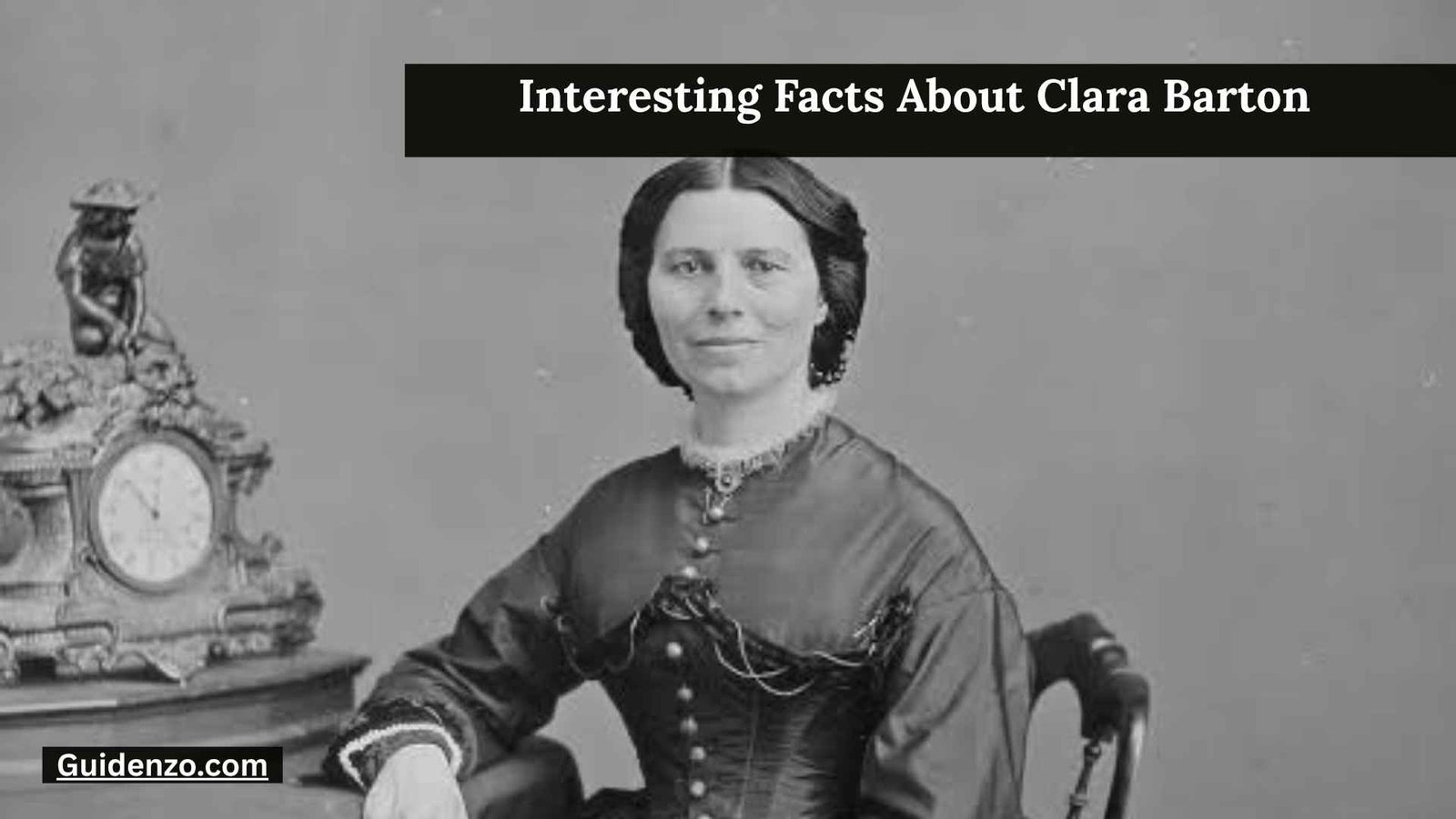
Clara Barton lived a life that still feels almost impossible. Born on Christmas Day in a quiet Massachusetts town, she became one of the most effective humanitarians the United States has ever produced. She nursed wounded soldiers under fire, tracked down tens of thousands of missing men, founded the American Red Cross, and expanded the very idea of what disaster relief could mean. These interesting facts about Clara Barton reveal a woman who combined fierce independence, practical courage, and an unshakable sense of duty.
Her story matters because it shows how one determined person can reshape institutions that still serve millions today. From Civil War battlefields to flood-ravaged towns, Barton’s work created systems that continue saving lives. What follows is a complete, carefully verified look at the woman behind the legend.
Quick Answer
Clara Barton (1821–1912) was a Civil War nurse known as the “Angel of the Battlefield,” founder and first president of the American Red Cross, and pioneer of organized disaster relief in the United States. She located more than 22,000 missing soldiers after the war, fought for equal pay as one of the first women in federal government service, and expanded the Red Cross mission beyond wartime to include natural disasters.
Quick Facts Table
| Category | Detail |
| Full Name | Clarissa Harlowe Barton |
| Born | December 25, 1821, North Oxford, Massachusetts |
| Died | April 12, 1912, Glen Echo, Maryland |
| Age at Death | 90 |
| Known For | Founding the American Red Cross; Civil War nursing |
| Nickname | Angel of the Battlefield |
| Key Achievement | Expanded Red Cross to peacetime disaster relief |
| Burial | North Cemetery, Oxford, Massachusetts |
| Fun Fact | A crater on Venus is named after her |
Main Interesting Facts
1. She Was Born on Christmas Day and Named After a Novel
Clarissa Harlowe Barton arrived on December 25, 1821, in North Oxford, Massachusetts. Her parents named her after the heroine of Samuel Richardson’s popular novel Clarissa. The youngest of five children, she grew up in a household shaped by her father’s Revolutionary War stories and her mother’s strong opinions. That Christmas birthdate later became a quiet symbol of the care she would give to others throughout her life. The literary name also hinted at the determination and moral clarity she would display for nine decades.
2. Extreme Shyness Defined Her Childhood
Barton suffered from such intense social anxiety that her family removed her from boarding school. She later wrote that she remembered “nothing but fear” in her early years. A phrenologist examined her skull and recommended teaching as a way to overcome her timid nature. The advice worked. Teaching forced her into public roles and slowly built the confidence that later allowed her to walk onto active battlefields.
3. Her First Nursing Experience Came at Age Eleven
When her brother David fell from a barn roof and suffered a severe head injury, eleven-year-old Clara took over his care. For nearly two years she administered medicine, applied leeches (standard treatment at the time), and stayed at his bedside. Doctors had largely given up. David recovered. That early responsibility planted the seed of the practical, hands-on caregiving style that defined her later work.
4. She Began Teaching at Age Seventeen
Barton passed the examinations required to teach and started her career at seventeen. She taught in several Massachusetts schools and later opened a free school in Bordentown, New Jersey. Within a year the school grew from six students to several hundred. When the town built a larger school and hired a male principal at a higher salary, Barton resigned rather than accept unequal treatment.
5. She Became One of the First Women to Hold a Federal Job with Equal Pay
In 1854 Barton moved to Washington, D.C., and took a position as a copyist in the U.S. Patent Office. She earned the same salary as the men in her office—an almost unheard-of arrangement at the time. Her outspoken opposition to slavery eventually cost her the job during the Buchanan administration, but she returned under Lincoln. The experience hardened her determination to demand fair treatment for women.
6. The First Battle of Bull Run Changed Everything
After the Union defeat at Bull Run in 1861, wounded soldiers flooded Washington. Barton distributed supplies from her own boardinghouse and began soliciting donations from the public. The chaotic medical response convinced her that organized civilian aid was essential. She spent the next months filling warehouses with bandages, food, and clothing that the army desperately needed.
7. She Arrived at Antietam with a Wagon Train of Supplies
On September 17, 1862—the bloodiest single day in American military history—Barton reached the battlefield with wagons of medical supplies. Surgeons were improvising bandages from corn husks. She worked through the night, cooking for soldiers and assisting doctors under fire. One surgeon later called her “the true heroine of the age, the angel of the battlefield.”
8. A Bullet Passed Through Her Sleeve and Killed the Soldier She Was Holding
While cradling a wounded man’s head and giving him water at Antietam, a bullet tore through the sleeve of her dress and struck the soldier, killing him instantly. Barton never mended the hole. She later wrote that she left him “to his rest” and moved on to the next man who needed help. The incident became one of the most vivid images of her wartime service.
9. She Operated Without Official Authority for Much of the War
Barton had no formal military rank or medical training when she began. She simply showed up with supplies and refused to leave. Only in 1864 did General Benjamin Butler appoint her superintendent of nurses for the Army of the James. Until then she functioned as an independent operator who had earned the respect of officers and surgeons through sheer effectiveness.
10. She Treated Confederate Prisoners as Well as Union Soldiers
Barton’s diaries record her care for wounded men from both sides. She believed suffering erased the lines of allegiance. This even-handed approach sometimes drew criticism, yet it reflected her core principle: meet the need in front of you without political calculation.
11. She Personally Funded Much of Her Early Work
Barton spent her own money buying supplies and arranging transportation. Congress later reimbursed her, and public donations helped, but the initial risk was hers. That financial independence gave her freedom to move quickly when official channels moved slowly.
12. She Located More Than 22,000 Missing Soldiers
After the war, families flooded her with letters asking about missing relatives. With President Lincoln’s approval she opened the Missing Soldiers Office. Her small staff answered more than 63,000 letters and identified roughly 22,000 men. Many families finally received confirmation of a death or the unexpected news that a loved one had survived.
13. She Helped Identify Nearly 13,000 Graves at Andersonville
Barton accompanied the expedition that marked the graves of Union prisoners who died at the infamous Andersonville camp in Georgia. Using a secret death register kept by a former prisoner, Dorence Atwater, the team identified thousands of previously anonymous graves. Barton raised the American flag for the first time over the new national cemetery.
14. She Traveled to Europe and Discovered the International Red Cross
Exhausted after the war, Barton sailed to Europe in 1869. There she learned about the International Committee of the Red Cross and the Geneva Convention. When the Franco-Prussian War erupted, she joined relief efforts in Strasbourg and elsewhere, wearing a red cross made of ribbon.
15. She Pushed the United States to Ratify the Geneva Convention
Returning home, Barton spent years lobbying presidents and Congress. The United States finally ratified the treaty in 1882. That legal step allowed the American Red Cross to operate under international protection and recognition.
16. She Founded the American Red Cross in 1881 at Age 59
On May 21, 1881, Barton and a small group of supporters formed the American Association of the Red Cross. She was elected its first president. The organization began with modest resources and a clear vision: help people in crisis regardless of the cause.
17. She Expanded the Red Cross Mission to Natural Disasters
Barton insisted that the American Red Cross respond to floods, fires, hurricanes, and epidemics as well as war. This “American Amendment” later influenced the International Red Cross. Her first major peacetime operation came after the Michigan forest fires of 1881.
18. The Johnstown Flood Became Her Most Celebrated Early Relief Effort
In 1889 a dam break killed more than 2,000 people in Johnstown, Pennsylvania. Barton arrived with supplies and stayed for months, distributing roughly $200,000 in goods and cash. The operation established the Red Cross as a trusted national disaster agency.
19. She Directed Relief After the Galveston Hurricane of 1900
The deadliest natural disaster in U.S. history left thousands dead on the Texas coast. At nearly 79 years old, Barton still oversaw Red Cross aid. The response reinforced the organization’s growing reputation for practical, large-scale assistance.
20. She Served as Red Cross President for 23 Years
Barton led the organization from 1881 until 1904. Critics eventually questioned her management style and age, and she resigned under pressure. Even her detractors acknowledged that the Red Cross existed in America largely because of her persistence.
21. She Established the National First Aid Association After Leaving the Red Cross
In 1905 Barton created a new organization focused on teaching first aid and organizing local ambulance brigades. The group distributed first-aid kits and trained civilians, extending her lifelong emphasis on practical preparedness.
22. She Was a Close Friend of Susan B. Anthony
Barton supported women’s suffrage and often shared platforms with Anthony. The two women respected each other’s work and spoke on behalf of each other’s causes. Their friendship linked humanitarian reform with the fight for women’s political rights.
23. She Received International Honors for Her Work
Among her decorations were the Prussian Iron Cross and the Russian Silver Cross. European leaders recognized the value of her relief efforts during the Franco-Prussian War and later disasters.
24. She Lived and Worked from a Warehouse in Glen Echo, Maryland
In the 1890s Barton built a large structure in Glen Echo that served as both Red Cross warehouse and her home. She lived there until her death. The building is now the Clara Barton National Historic Site, the first National Park Service site dedicated to the achievements of a woman.
25. She Wrote Several Books About Her Experiences
Barton published The Red Cross in Peace and War, A Story of the Red Cross, and The Story of My Childhood. These works preserved her perspective and helped educate the public about organized relief.
26. She Survived Smallpox as a Child
Having contracted and recovered from smallpox in her youth gave Barton lifelong immunity. That immunity later allowed her to work safely among infected populations during wartime epidemics.
27. She Taught Formerly Enslaved People to Read
During the Civil War, Barton employed formerly enslaved people as nurses and taught many of them to read. She saw literacy as another form of practical empowerment.
28. She Was Still Active in Relief Work at Age 77
During the Spanish-American War, Barton traveled to Cuba and directed Red Cross assistance for wounded sailors and civilians. Age never fully slowed her field work.
29. A Crater on Venus Bears Her Name
In recognition of her global impact, planetary scientists named a crater on Venus after Clara Barton. The honor places her among a select group of women whose names mark the solar system.
30. She Died Three Days Before the Titanic Disaster
Barton died of pneumonia on April 12, 1912, at her Glen Echo home. Three days later the Titanic sank. The American Red Cross she founded immediately began assisting survivors and families—an early demonstration that her organization would outlive her.
31. She Never Married and Lived Independently
Barton remained single throughout her life. She valued the freedom that allowed her to travel and take risks without family obligations. Close friendships and professional partnerships sustained her instead.
32. Her Father Encouraged Her Battlefield Service
On his deathbed in 1862, Captain Stephen Barton told his daughter that soldiers would respect her presence and that she should seek out those in need. Within months she was on the front lines, fulfilling his final advice.
33. She Was a Founding Member of the Daughters of the American Revolution
Barton joined the DAR as National Number 160 and served as the organization’s first Surgeon General. Her Revolutionary War ancestry and lifelong patriotism made the role a natural fit.
34. She Faced Criticism for Authoritarian Leadership
Later in her Red Cross tenure, some board members complained that Barton made decisions without consultation and kept poor financial records. The tension led to her resignation. Historians note that the same independent streak that built the organization eventually limited its modernization under her leadership.
35. She Worked Through Depression and Exhaustion
Barton experienced periods of deep depression, especially after intense campaigns. Yet the call of a new crisis almost always revived her energy. Colleagues observed that nothing restored her more completely than the chance to help people in immediate need.
Timeline of Key Milestones

- 1821 – Born December 25 in North Oxford, Massachusetts
- 1832–1834 – Nurses brother David after serious injury
- 1839 – Begins teaching career
- 1852 – Opens free school in Bordentown, New Jersey
- 1854 – Joins U.S. Patent Office as one of the first women clerks
- 1861 – Begins Civil War relief work after First Bull Run
- 1862 – Serves at Antietam; earns “Angel of the Battlefield” nickname
- 1864 – Appointed superintendent of nurses for the Army of the James
- 1865–1868 – Directs Missing Soldiers Office; identifies more than 22,000 men
- 1869–1873 – Travels in Europe; works with International Red Cross
- 1881 – Founds American Association of the Red Cross
- 1882 – United States ratifies Geneva Convention
- 1889 – Leads Johnstown Flood relief
- 1900 – Directs Galveston Hurricane relief
- 1904 – Resigns as Red Cross president
- 1905 – Establishes National First Aid Association of America
- 1912 – Dies April 12 in Glen Echo, Maryland
Statistics Table
| Achievement | Number |
| Missing soldiers identified | More than 22,000 |
| Letters answered by Missing Soldiers Office | More than 63,000 |
| Graves marked at Andersonville | Nearly 13,000 |
| Years as American Red Cross president | 23 |
| Age when she founded the Red Cross | 59 |
| Age at death | 90 |
| Civil War battlefields served | At least 16 |
Myth vs Fact
| Myth | Fact |
| Barton was a trained professional nurse | She had no formal medical training; her skills came from experience |
| She single-handedly identified all Andersonville graves | She accompanied the expedition and publicized the work; Dorence Atwater’s register was crucial |
| She only helped Union soldiers | She treated wounded men from both sides when possible |
| The Red Cross was purely her invention | She adapted the existing International Red Cross model to America and expanded its mission |
| She remained popular with all colleagues until the end | Management criticism forced her resignation in 1904 |
Common Misconceptions
Many people assume Clara Barton was simply “a Civil War nurse.” That label understates her range. She was an educator, federal employee, supply organizer, missing-persons investigator, international diplomat, and institution builder. Another frequent misunderstanding is that the American Red Cross appeared fully formed. Barton spent more than a decade of lobbying, writing, and organizing before the United States accepted the Geneva Convention and created a permanent national society. Finally, some accounts romanticize her as a saintly figure immune to conflict. In reality she was a strong-willed administrator whose independence both created the Red Cross and eventually led to her departure from it.
Why This Topic Matters
Clara Barton’s life demonstrates that effective humanitarian systems do not appear automatically. They require individuals willing to invent procedures, raise money, lobby governments, and show up when conditions are dangerous. The American Red Cross still responds to disasters every year because Barton insisted that peacetime calamities deserved the same organized response as war. Her example also shows how women in the nineteenth century could exercise national influence even without the vote. Understanding her methods helps explain why modern disaster relief looks the way it does and why private voluntary organizations remain essential partners to government.
Related Discoveries
Barton’s work connects directly to the broader history of the International Red Cross, founded after the Battle of Solferino and the efforts of Henry Dunant. It also intersects with the growth of professional nursing, the women’s suffrage movement, and the development of national cemeteries and missing-in-action accounting systems. Her Missing Soldiers Office prefigured later military efforts to identify and repatriate remains. The Clara Barton National Historic Site and the Missing Soldiers Office Museum in Washington preserve physical evidence of her daily operations.
Expert Insights
Historians emphasize that Barton’s greatest contribution was organizational rather than purely medical. She understood logistics, public communication, and the power of a recognizable emblem. By attaching the Red Cross name to disaster relief, she created a trusted brand that could raise money and mobilize volunteers faster than ad-hoc efforts. Modern emergency managers still study her Johnstown and Galveston operations for lessons in rapid deployment and coordination with local authorities. Her insistence on neutrality—helping anyone in need—also remains a core principle of the Red Cross movement worldwide.
Frequently Asked Questions
What was Clara Barton’s real name?
Clarissa Harlowe Barton. She preferred the shorter form Clara throughout her adult life.
Why is Clara Barton called the Angel of the Battlefield?
A Union surgeon coined the phrase after watching her work under fire at Antietam in 1862. The nickname stuck because it captured both her courage and the comfort she brought to wounded soldiers.
Did Clara Barton have formal medical training?
No. She learned practical care by nursing her brother and through battlefield experience. Her strength lay in organization and supply rather than surgical skill.
How many missing soldiers did she find?
Her office identified more than 22,000 men and answered over 63,000 letters from families.
When was the American Red Cross founded?
May 21, 1881. Barton served as its first president until 1904.
What disasters did the early Red Cross respond to under Barton?
Michigan forest fires, Ohio and Mississippi River floods, the Johnstown Flood, the Galveston Hurricane, and several others, plus wartime work in Cuba.
Where is Clara Barton buried?
North Cemetery in Oxford, Massachusetts, near her birthplace.
Was Clara Barton involved in women’s suffrage?
Yes. She supported the cause and maintained a close friendship with Susan B. Anthony.
What happened to her home in Glen Echo?
It is preserved as the Clara Barton National Historic Site, administered by the National Park Service.
How old was she when she died?
Clara Barton died at age 90 on April 12, 1912.
Key Takeaways
- Clara Barton transformed personal courage into lasting institutions.
- She proved that organized civilian relief could operate effectively alongside military forces.
- Expanding the Red Cross to natural disasters created a model still used worldwide.
- Her Missing Soldiers Office gave thousands of families closure after the Civil War.
- Equal pay, women’s leadership, and practical first-aid training were consistent themes in her career.
- The American Red Cross exists today largely because of her persistence between 1869 and 1882.
- Physical sites in Maryland and Washington, D.C., preserve the places where she lived and worked.
Conclusion
These interesting facts about Clara Barton reveal far more than a series of heroic anecdotes. They show a woman who repeatedly turned private determination into public systems that still function more than a century after her death.
From a shy Massachusetts child to the founder of the American Red Cross, Barton’s life remains one of the clearest American examples of how practical compassion can reshape national institutions. Her story continues to matter every time the Red Cross responds to a flood, fire, or hurricane—and every time families receive news about a missing service member. That is the real measure of the work she began.
References
- U.S. National Park Service, Clara Barton biography and chronologies
- Encyclopaedia Britannica, Clara Barton entry
- American Battlefield Trust, “10 Facts: Clara Barton”
- History.com, Clara Barton articles and facts
- Library of Congress, Clara Barton Papers timeline
- National Museum of the United States Army biography
- Clara Barton Missing Soldiers Office Museum materials

I am Henry Calloway, an independent researcher and writer who enjoys finding extraordinary facts in ordinary places. From mysterious historical events to remarkable discoveries in nature and science, I believe every subject has a surprising side. I write to entertain curious minds and make complex information easy for everyone.
Books:
- Strange But True: Facts From Around the World
- The Unexpected Guide to Everything