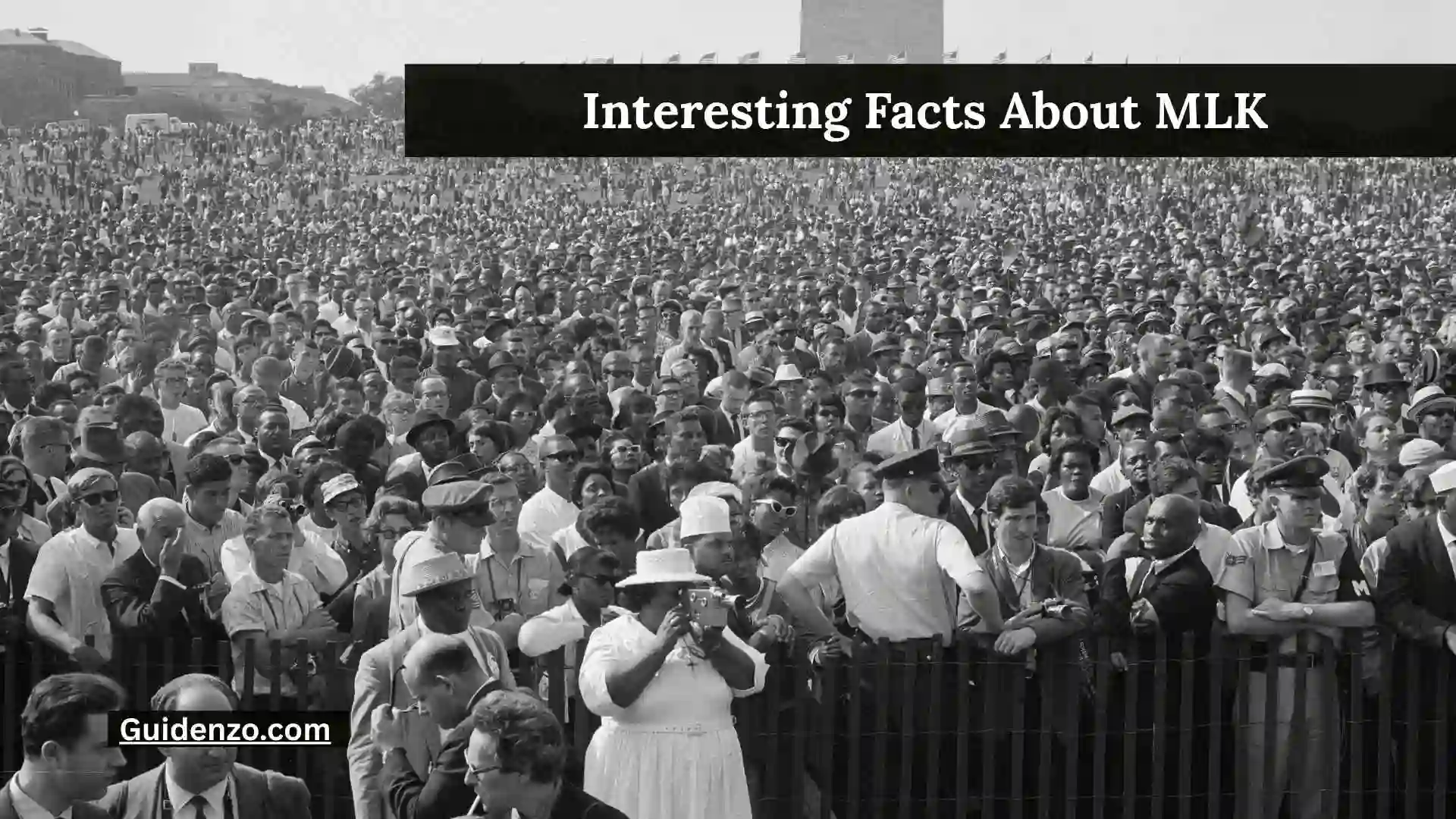
Martin Luther King Jr. remains one of the most transformative figures in American history. His name is synonymous with the Civil Rights Movement, nonviolent resistance, and the fight for racial equality. Yet behind the iconic speeches and familiar images lie layers of personal details, surprising decisions, and lesser-known moments that shaped both the man and the movement.
These interesting facts about MLK go beyond the textbook version. They reveal a gifted student who entered college at 15, a leader who survived an earlier assassination attempt, a thinker deeply influenced by Gandhi, and a pastor whose commitment to justice cost him his life at just 39. From his birth name to the improvisation of his most famous speech, the story of Martin Luther King Jr. is richer, more human, and more complex than many realize.
This article gathers verified, meaningful details about his life, work, and legacy so readers can understand not only what he accomplished but why his example still matters.
Quick Answer
Martin Luther King Jr. was born Michael King Jr. on January 15, 1929, in Atlanta, Georgia. He became the leading voice of the American Civil Rights Movement, advocated nonviolent protest inspired by Gandhi, delivered the “I Have a Dream” speech in 1963, won the Nobel Peace Prize in 1964 at age 35, and was assassinated on April 4, 1968, in Memphis, Tennessee. His work helped dismantle legal segregation and continues to influence global human rights efforts.
Quick Facts Table
| Category | Detail |
| Full Name | Martin Luther King Jr. (born Michael King Jr.) |
| Born | January 15, 1929, Atlanta, Georgia |
| Died | April 4, 1968 (age 39), Memphis, Tennessee |
| Occupation | Baptist minister, civil rights leader |
| Key Movement | American Civil Rights Movement |
| Major Award | Nobel Peace Prize (1964) |
| Famous Speech | “I Have a Dream” (1963) |
| National Holiday | Martin Luther King Jr. Day (third Monday in January) |
| Fun Fact | Entered college at age 15 |
Main Interesting Facts
1. His Birth Name Was Michael, Not Martin
Martin Luther King Jr. was born Michael King Jr. on January 15, 1929. When he was five, his father traveled to Germany and became inspired by the Protestant reformer Martin Luther. Upon returning, Michael King Sr. changed both his own name and his son’s to Martin Luther King. The change reflected a deliberate link to a historic figure of religious reform and personal conviction. This early renaming quietly set a tone of purpose that would define the younger King’s life. Many people still assume he was always called Martin, overlooking this intentional family decision.
2. He Entered College at Age 15
King skipped the ninth and twelfth grades and enrolled at Morehouse College in Atlanta at just 15 years old. Both his father and maternal grandfather had attended the same historically Black institution. His academic ability and the encouragement of mentors allowed him to begin higher education unusually early. This head start placed him among older students while he was still forming his worldview. The experience at Morehouse exposed him to ideas about social justice and leadership that would later guide his public work.
3. He First Encountered Gandhi’s Ideas in College
While studying at Morehouse and later in seminary, King learned about Mahatma Gandhi’s philosophy of nonviolent resistance. The concept of satyagraha—truth force—deeply impressed him. He later traveled to India in 1959 to study the methods firsthand. Gandhi’s approach gave King a practical framework for challenging injustice without violence. This intellectual and spiritual connection became the backbone of the Civil Rights Movement’s most effective campaigns.
4. The Montgomery Bus Boycott Launched His National Role
In 1955, after Rosa Parks was arrested for refusing to give up her seat, the Black community in Montgomery, Alabama, organized a boycott of the city’s buses. King, then a young pastor, was chosen to lead the effort. The boycott lasted 381 days and ended only after the U.S. Supreme Court ruled bus segregation unconstitutional. The success made King a national figure almost overnight. It also demonstrated that disciplined, nonviolent mass action could force legal change.
5. He Was Arrested Nearly 30 Times
King was jailed approximately 29 times for acts of civil disobedience and, on occasion, for minor or fabricated charges. One of the most significant arrests occurred in Birmingham in 1963, where he wrote the famous “Letter from Birmingham Jail.” Time spent behind bars became both a personal sacrifice and a powerful symbol of the cost of demanding equality. His willingness to accept imprisonment reinforced the moral authority of the movement.
6. He Survived a Near-Fatal Stabbing in 1958
On September 20, 1958, while signing books in a Harlem department store, a woman named Izola Ware Curry stabbed King in the chest with a letter opener. The blade came within a fraction of an inch of his aorta. Surgeons later told him that a sneeze could have killed him. King recovered and later reflected on the incident with remarkable grace, noting that the experience deepened his commitment to nonviolence. The attack foreshadowed the violence that would eventually claim his life.
7. The “I Have a Dream” Speech Was Partly Improvised
The most famous portion of King’s August 28, 1963, address at the March on Washington was not in the original prepared text. Advisors had cautioned against using the “dream” language. During the speech, gospel singer Mahalia Jackson called out, “Tell them about the dream, Martin.” King shifted from his notes and delivered the soaring vision that defined the moment. The improvisation turned a carefully crafted address into one of the most memorable speeches in American history.
8. He Became the Youngest Nobel Peace Prize Winner at the Time

In 1964, at age 35, King received the Nobel Peace Prize for his nonviolent campaign against racial inequality. He was the youngest person to win the award up to that point. He announced that the prize money of more than $54,000 would go entirely to the civil rights cause. The recognition elevated the American struggle for racial justice onto the world stage and affirmed the power of nonviolent methods.
9. He Traveled More Than Six Million Miles
Between 1957 and 1968, King logged over six million miles and delivered more than 2,500 speeches. He appeared wherever injustice demanded a response, from Southern towns to Northern cities and international forums. The constant travel took a physical toll and kept him away from his family for long stretches. Yet it also built a national network of support and kept the movement visible across the country.
10. He Wrote Five Books and Numerous Articles
Despite the demands of leadership, King produced a substantial body of written work. His books include Stride Toward Freedom, Why We Can’t Wait, and Where Do We Go from Here: Chaos or Community? These writings offered both theological reflection and practical strategy. They remain essential reading for anyone seeking to understand the intellectual foundations of the Civil Rights Movement.
11. He Co-Pastored Ebenezer Baptist Church
King followed in the footsteps of his father and grandfather as a minister at Atlanta’s Ebenezer Baptist Church. From 1960 until his death he served as co-pastor. The pulpit remained central to his identity even as his public role expanded. Preaching allowed him to root the fight for justice in Christian ethics and to speak directly to the moral conscience of the nation.
12. He Married Coretta Scott in 1953
King met Coretta Scott while studying in Boston. They married in 1953 and had four children: Yolanda, Martin Luther III, Dexter, and Bernice. Coretta became a partner in the movement, often speaking and organizing in her own right. After her husband’s death she continued the work of the King Center and preserved his legacy for future generations.
13. He Was Named Time Magazine’s Man of the Year
In 1963, the year of the Birmingham campaign and the March on Washington, Time named King its Man of the Year. The recognition reflected the growing national impact of the movement he led. It also marked a shift in how mainstream media portrayed the struggle for civil rights.
14. He Opposed the Vietnam War
In the later years of his life, King publicly criticized U.S. involvement in Vietnam. His 1967 speech “Beyond Vietnam” linked the war to domestic poverty and racial injustice. The stance cost him support among some allies and drew sharp criticism from political leaders. He insisted that moral consistency required speaking against all forms of violence and injustice.
15. He Was Planning the Poor People’s Campaign When He Died
In 1968 King was organizing a major campaign focused on economic justice. The Poor People’s Campaign aimed to bring people of all races to Washington, D.C., to demand better jobs, housing, and income. He was in Memphis supporting striking sanitation workers when he was killed. The campaign continued after his death but never achieved the scale he envisioned.
16. James Earl Ray Was Convicted of His Assassination
On April 4, 1968, King was shot while standing on the balcony of the Lorraine Motel in Memphis. James Earl Ray pleaded guilty and received a 99-year sentence. Questions and conspiracy theories have persisted for decades, yet the official legal record holds Ray responsible. King’s death triggered riots in more than 100 American cities and accelerated passage of the Fair Housing Act.
17. He Is the Only Non-President with a Federal Holiday
Martin Luther King Jr. Day became a federal holiday in 1986, observed on the third Monday of January. He is the only private citizen to receive this honor. The day is often marked by service projects as well as remembrance, reflecting his emphasis on practical action for justice.
18. A National Memorial Stands on the National Mall
The Martin Luther King Jr. Memorial in Washington, D.C., was dedicated in 2011. It is the first memorial on the National Mall to honor a Black American. The design, featuring King emerging from a stone of hope, draws directly from language in the “I Have a Dream” speech. Its location near the Lincoln and Jefferson memorials places him among the nation’s most significant historical figures.
19. He Received the Presidential Medal of Freedom Posthumously
In 1977 President Jimmy Carter awarded King the Presidential Medal of Freedom. The honor recognized his extraordinary contributions to the nation. Additional recognition, including the Congressional Gold Medal, followed in later years.
20. His Father and Grandfather Were Also Pastors
The King family tradition of ministry stretched across generations. His grandfather A.D. Williams and father Martin Luther King Sr. both led Ebenezer Baptist Church. This religious heritage shaped King’s understanding of the church as a force for social change rather than merely a place of worship.
21. He Earned a Doctorate from Boston University
After graduating from Morehouse and completing seminary at Crozer, King earned his Ph.D. in systematic theology from Boston University in 1955. His dissertation examined the concept of God in the thinking of Paul Tillich and Henry Nelson Wieman. Academic training gave him the intellectual tools to articulate a theology of justice that resonated far beyond the academy.
22. He Was Influenced by Both Christianity and Secular Philosophy
King drew on the Black church tradition, the Social Gospel, and Western philosophy. He studied Hegel, Nietzsche, and existentialist thinkers alongside biblical texts. The combination produced a distinctive moral vision that spoke to both religious and secular audiences.
23. The Southern Christian Leadership Conference Was Founded Under His Leadership
In 1957 King and other ministers established the Southern Christian Leadership Conference (SCLC) to coordinate nonviolent action across the South. As its first president, he helped turn scattered local efforts into a coordinated national movement. The SCLC became one of the most important organizations of the Civil Rights era.
24. He Met with Presidents Kennedy and Johnson
King conferred with President John F. Kennedy and later with President Lyndon B. Johnson. These relationships were often tense, yet they helped produce landmark legislation including the Civil Rights Act of 1964 and the Voting Rights Act of 1965. Direct access to the White House amplified the movement’s political leverage.
25. He Believed Unarmed Truth Would Prevail
In his Nobel acceptance speech King declared that “unarmed truth and unconditional love will have the final word in reality.” The statement captured his enduring faith that moral force ultimately overcomes violence and hatred. It remains one of the clearest expressions of his philosophy.
26. He Faced Constant Death Threats
Throughout his public life King received threats, bombings of his home, and surveillance by the FBI. He accepted the danger as the price of challenging the status quo. His ability to continue speaking and organizing under such pressure demonstrated extraordinary personal courage.
27. His Final Speech Foreshadowed His Death
On the night before his assassination, King delivered the “I’ve Been to the Mountaintop” speech in Memphis. He spoke of reaching the promised land even if he might not get there with others. The remarks have been widely interpreted as a premonition. The speech remains one of his most powerful and emotionally charged addresses.
28. He Inspired Global Human Rights Movements
King’s example influenced anti-apartheid activists in South Africa, democracy movements in Eastern Europe, and countless other struggles for justice. Nonviolent resistance as a strategy gained worldwide credibility partly through his success in the United States.
29. The Fair Housing Act Passed Shortly After His Death
Just days after the assassination, Congress passed the Civil Rights Act of 1968, which included the Fair Housing Act. The legislation prohibited discrimination in housing and was widely seen as a legislative response to the national grief and unrest that followed his murder.
30. He Continues to Shape American Civic Life
Statues, street names, schools, and annual observances keep King’s memory present in daily life. More importantly, the questions he raised about race, poverty, and violence remain central to American public debate. His legacy is not frozen in the past but continues to challenge each new generation.
31. He Skipped Two Grades in High School
King’s academic talent allowed him to advance rapidly through secondary school. Skipping grades reflected both his ability and the limited educational opportunities available to Black students in the segregated South. The acceleration prepared him for the demanding intellectual and public life that followed.
32. He Was Elected President of His Seminary Class
At Crozer Theological Seminary, a predominantly white institution, King was elected president of the senior class. The achievement demonstrated his ability to earn respect across racial lines even in the early 1950s. Leadership experience at Crozer foreshadowed his later national role.
33. He Donated All Nobel Prize Money to the Movement
Rather than keep the substantial prize money, King directed every dollar toward civil rights organizations. The decision reinforced his public image as a servant leader rather than a celebrity. It also provided practical resources for ongoing campaigns.
34. He Faced Criticism from Both Moderates and Militants
Some white moderates urged him to slow down; some Black militants argued that nonviolence was too passive. King navigated these competing pressures while remaining committed to his core principles. The tension revealed the complexity of building a broad coalition for change.
35. His Children Have Continued Public Work
Yolanda, Martin Luther III, Dexter, and Bernice King have each contributed to preserving and extending their father’s legacy through speaking, organizing, and institutional leadership. The family remains an active part of the ongoing conversation about civil rights and social justice.
36. The Lorraine Motel Is Now a Civil Rights Museum
The site of the assassination was transformed into the National Civil Rights Museum. Visitors can stand near the balcony where King was shot and learn the broader history of the movement. The museum turns a place of tragedy into a center of education and remembrance.
37. He Advocated for Economic Justice as Well as Racial Equality
In his final years King increasingly linked racial justice to economic opportunity. He spoke about guaranteed income, fair wages, and the structural causes of poverty. This broader vision expanded the movement beyond legal desegregation.
38. He Studied Nonviolence in India
King’s 1959 trip to India deepened his understanding of Gandhi’s methods. He returned more convinced than ever that nonviolent resistance was the most powerful weapon available to oppressed people. The journey strengthened both his strategy and his resolve.
39. His Birthday Is Celebrated with Service
Many communities observe Martin Luther King Jr. Day as a day of service rather than simply a holiday. The practice reflects his belief that real change requires active participation, not passive remembrance.
40. He Remains a Global Symbol of Moral Courage
More than half a century after his death, King’s image and words continue to appear in movements for justice around the world. His life demonstrates that determined, principled action can alter the course of a nation.
Timeline of Key Milestones
- 1929: Born Michael King Jr. in Atlanta, Georgia.
- 1944: Enters Morehouse College at age 15.
- 1953: Marries Coretta Scott.
- 1955: Completes Ph.D.; leads Montgomery Bus Boycott after Rosa Parks’ arrest.
- 1957: Helps found the Southern Christian Leadership Conference.
- 1958: Survives stabbing in Harlem.
- 1959: Travels to India to study nonviolence.
- 1963: Leads Birmingham campaign; delivers “I Have a Dream” speech.
- 1964: Receives Nobel Peace Prize; Civil Rights Act signed.
- 1965: Voting Rights Act becomes law after Selma campaign.
- 1967: Publicly opposes the Vietnam War.
- 1968: Assassinated in Memphis while supporting sanitation workers.
Statistics Table
| Statistic | Figure |
| Age at death | 39 |
| Years of major public leadership | Approximately 13 (1955–1968) |
| Nobel Peace Prize age | 35 |
| Approximate number of arrests | 29 |
| Miles traveled (1957–1968) | Over 6 million |
| Speeches delivered | Over 2,500 |
| Duration of Montgomery Bus Boycott | 381 days |
| March on Washington attendance | Approximately 250,000 |
Myth vs Fact
| Myth | Fact |
| King was always named Martin | He was born Michael King Jr. and renamed at age five |
| The “I Have a Dream” speech was fully prepared | The most famous section was largely improvised |
| He only fought for racial equality | He also addressed poverty and opposed the Vietnam War |
| Nonviolence was passive | It was a disciplined, strategic form of active resistance |
| He enjoyed universal support | He faced criticism from both moderates and more radical activists |
Common Misconceptions
One widespread misunderstanding is that King was universally beloved during his lifetime. In reality he was a controversial figure who challenged powerful interests and faced intense opposition, including from the FBI. Another misconception is that the Civil Rights Movement ended legal segregation solely through court victories; mass nonviolent action was essential in creating the political pressure that made those victories possible. Some also reduce King’s message to a single speech, overlooking his broader critique of economic inequality and militarism.
Why This Topic Matters
Understanding the full scope of Martin Luther King Jr.’s life helps people see that progress toward justice is neither automatic nor complete. His example shows that ordinary individuals, guided by clear principles and organized effort, can reshape national institutions. In a time of renewed debates about race, inequality, and political polarization, the methods and moral clarity he demonstrated remain relevant tools for constructive change.
Related Discoveries and Concepts
King’s work connects directly to the philosophy of nonviolent resistance developed by Gandhi, the Social Gospel tradition in American Christianity, and the long history of African American protest. Figures such as Rosa Parks, Bayard Rustin, Ella Baker, and John Lewis played complementary roles. The legal milestones of the era—the Civil Rights Act, Voting Rights Act, and Fair Housing Act—stand as institutional outcomes of the movement he helped lead.
Expert Insights
King’s greatness lay not only in eloquence but in strategic patience and moral consistency. He understood that lasting change required both moral suasion and political pressure. He also recognized that racial justice could not be separated from economic opportunity. Contemporary organizers who study his campaigns often note the importance of disciplined nonviolence, broad coalition-building, and the willingness to accept personal cost. These lessons continue to inform movements for human rights worldwide.
Frequently Asked Questions
What was Martin Luther King Jr.’s real name at birth?
He was born Michael King Jr. His father later changed both of their names to Martin Luther King after being inspired by the Protestant reformer Martin Luther.
How old was King when he entered college?
He enrolled at Morehouse College at age 15 after skipping two grades in high school.
When did King give the “I Have a Dream” speech?
He delivered the speech on August 28, 1963, during the March on Washington for Jobs and Freedom.
Did King win the Nobel Peace Prize?
Yes. He received the award in 1964 at the age of 35, becoming the youngest winner at that time.
How did Martin Luther King Jr. die?
He was assassinated by gunshot on April 4, 1968, while standing on the balcony of the Lorraine Motel in Memphis, Tennessee.
Was King only focused on racial issues?
No. In his later years he increasingly addressed economic inequality and publicly opposed the Vietnam War.
Why is there a federal holiday for King?
Martin Luther King Jr. Day was established to honor his contributions to civil rights and is observed as a national day of service.
Did King invent nonviolent protest?
No. He adapted and applied the philosophy of nonviolent resistance developed by Mahatma Gandhi to the American context.
How many times was King arrested?
He was arrested approximately 29 times, mostly for acts of civil disobedience.
What is the significance of the King Memorial in Washington, D.C.?
It is the first memorial on the National Mall dedicated to a Black American and stands as a permanent reminder of his role in the nation’s history.
Key Takeaways
- Martin Luther King Jr. was born Michael King Jr. and renamed after the Protestant reformer.
- He entered college at 15 and earned a doctorate by age 26.
- Nonviolent resistance, inspired by Gandhi, was central to his strategy.
- The “I Have a Dream” speech was partly improvised after encouragement from Mahalia Jackson.
- He won the Nobel Peace Prize at 35 and donated the money to the movement.
- He was arrested nearly 30 times and survived an earlier stabbing.
- His later work expanded to poverty and opposition to the Vietnam War.
- He was assassinated at 39 while supporting striking workers in Memphis.
- A federal holiday and a National Mall memorial honor his legacy.
- His methods and moral vision continue to influence justice movements worldwide.
Conclusion
These interesting facts about MLK reveal a man of extraordinary intellect, courage, and moral clarity. From a gifted teenager who entered college early to a global symbol of nonviolent change, Martin Luther King Jr. transformed American society in little more than a decade of public leadership.
His story is not simply a collection of dramatic moments; it is a demonstration of how disciplined commitment to justice can alter the direction of a nation. Remembering the full scope of his life—beyond the familiar quotations—keeps the challenge of his example alive for every generation that follows.
References
- The King Center (thekingcenter.org)
- National Museum of African American History and Culture (nmaahc.si.edu)
- Nobel Prize official biography (nobelprize.org)
- Stanford University Martin Luther King, Jr. Research and Education Institute
- Britannica Biography of Martin Luther King Jr.
- History.com coverage of Martin Luther King Jr.
I am Amelia Whitmore, a writer fascinated by the strange, wonderful, and often overlooked details of our world. I love researching unusual facts about people, places, animals, and history. My goal is to share knowledge in a friendly way that sparks curiosity and encourages readers to keep discovering something new.
Books:
- Amazing Facts You Never Learned at School
- The Little Book of Big Surprises