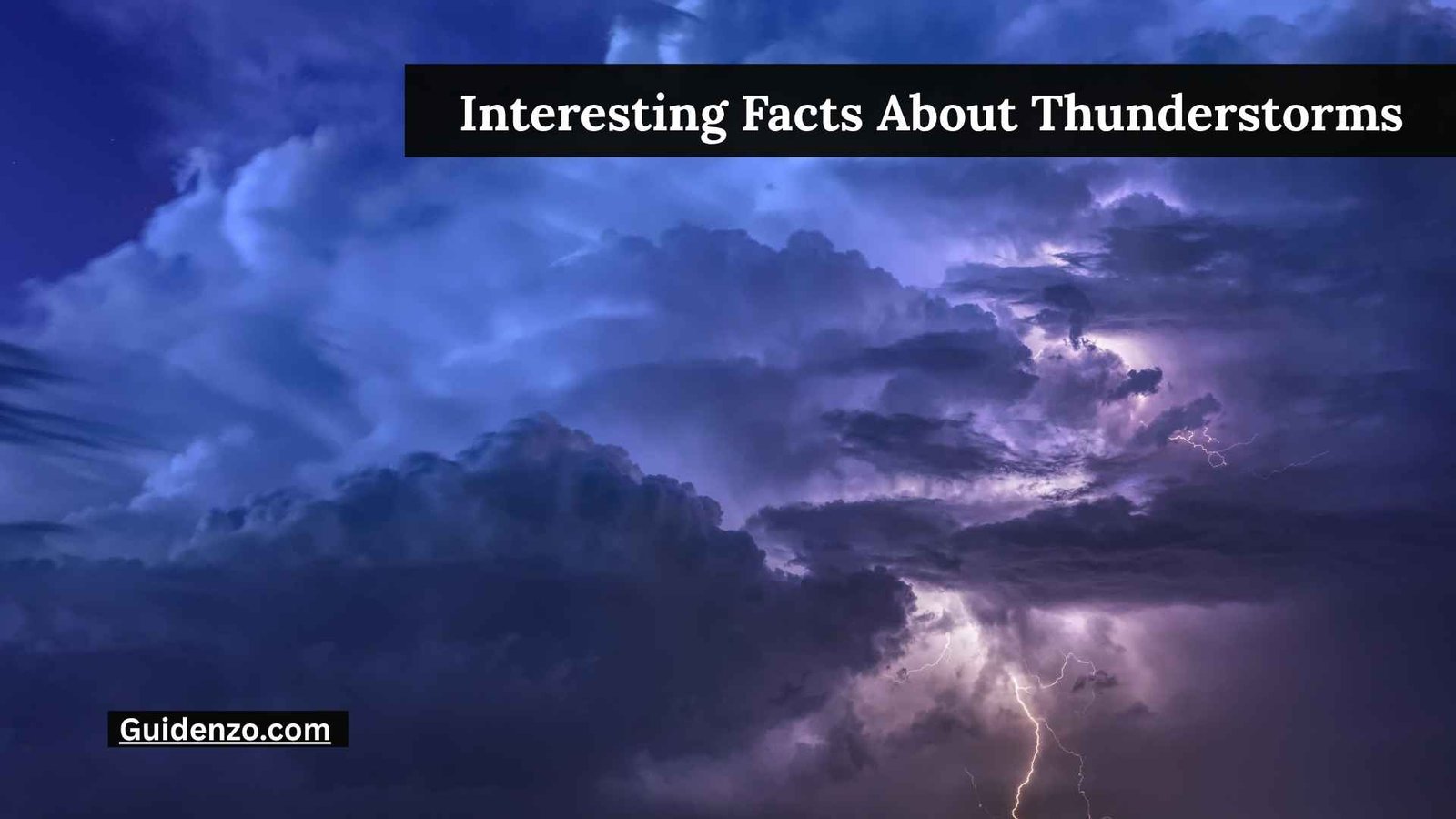
Interesting facts about thunderstorms show how one of Earth’s most dramatic weather events combines electricity, heat, water, and powerful atmospheric forces into a spectacular natural display. A thunderstorm can produce brilliant lightning flashes, booming thunder, heavy rain, strong winds, hail, and even dangerous tornadoes.
Although thunderstorms happen every day around the world, each storm is a complex scientific event involving millions of tiny processes inside the atmosphere. From the formation of towering clouds to the creation of lightning strikes that heat the air thousands of degrees, thunderstorms reveal the incredible energy stored in Earth’s weather system.
In this guide, you will discover how thunderstorms form, why lightning happens, how scientists study storms, surprising records, common myths, safety information, and dozens of fascinating facts that explain why thunderstorms are among nature’s most powerful phenomena.
Quick Answer
Thunderstorms are powerful weather systems created when warm, moist air rises rapidly into cooler parts of the atmosphere. They produce lightning, thunder, heavy rain, strong winds, and sometimes hail or tornadoes. Thunderstorms occur worldwide and play an important role in Earth’s water cycle by moving heat and moisture through the atmosphere.
Quick Facts About Thunderstorms
| Topic | Information |
| Category | Severe weather phenomenon |
| Scientific Study | Meteorology and atmospheric science |
| Formation | Warm, moist air rising into unstable atmosphere |
| Main Cloud Type | Cumulonimbus cloud |
| Global Location | Occur on every continent except Antarctica |
| Average Size | Around 15–25 miles (24–40 km) wide |
| Typical Lifespan | About 30 minutes to several hours |
| Lightning Temperature | Up to about 50,000°F (27,700°C) |
| Main Elements | Lightning, thunder, rain, wind, hail |
| Fun Fact | A single lightning bolt can heat surrounding air hotter than the surface of the Sun |
Interesting Facts About Thunderstorms
1. Thunderstorms Are Giant Atmospheric Machines
The Fact
A thunderstorm is not simply a dark cloud with rain. It is a massive atmospheric machine powered by warm air, moisture, and temperature differences. Inside a mature thunderstorm, air can rise at incredible speeds, forming towering clouds that may reach more than 40,000 feet into the sky.
Why It Matters
Understanding thunderstorms helps scientists predict dangerous weather and improve warnings for communities. These storms influence global weather patterns by transporting heat and moisture from Earth’s surface into the upper atmosphere.
Did You Know?
The tallest thunderstorms can reach heights close to the cruising altitude of commercial airplanes.
Additional Context
The main engine of a thunderstorm is the updraft, which carries warm, moist air upward. As this air rises and cools, water vapor condenses into clouds and releases heat, giving the storm additional energy.
2. Thunderstorms Form Inside Cumulonimbus Clouds
The Fact
Most thunderstorms develop from cumulonimbus clouds, which are large, vertical clouds with a towering appearance. These clouds form when strong upward air movement pushes moisture high into the atmosphere.
Why It Matters
The shape and structure of cumulonimbus clouds help meteorologists identify potential thunderstorms before they fully develop.
Did You Know?
The word “cumulonimbus” comes from Latin words meaning “heap” and “rainstorm.”
Additional Context
Unlike flat clouds that produce normal rain, cumulonimbus clouds grow vertically because powerful rising air currents continue feeding the cloud system.
3. Lightning Is a Massive Electrical Discharge
The Fact
Lightning occurs when electrical charges build up inside a thunderstorm and suddenly discharge through the atmosphere. Most lightning happens within clouds, but some bolts travel from clouds to the ground.
Why It Matters
Lightning is one of the most dangerous parts of thunderstorms because it can start fires, damage structures, and injure people.
Did You Know?
A lightning bolt can contain hundreds of millions of volts of electrical energy.
Additional Context
Scientists believe collisions between ice particles, water droplets, and hail inside storm clouds help separate positive and negative electrical charges, creating the conditions needed for lightning.
4. Thunder Is Created by Rapid Air Expansion
The Fact
Thunder is the sound produced when lightning rapidly heats the surrounding air. The sudden increase in temperature causes the air to expand explosively, creating a shock wave that travels as sound.
Why It Matters
Thunder allows people to detect lightning even when they cannot see the flash.
Did You Know?
The reason you see lightning before hearing thunder is that light travels much faster than sound.
Additional Context
The closer a person is to a lightning strike, the shorter the delay between the flash and the sound of thunder.
5. Lightning Can Be Hotter Than the Sun’s Surface
The Fact
A lightning channel can heat the surrounding air to temperatures of around 50,000°F (27,700°C), which is several times hotter than the surface of the Sun.
Why It Matters
This extreme heat explains why lightning creates thunder and why it can instantly heat or damage objects it touches.
Did You Know?
The intense heat causes the air around lightning to expand so quickly that it creates the explosive sound of thunder.
Additional Context
Although lightning is extremely hot, it lasts only a fraction of a second. Its brief duration prevents the entire surrounding area from becoming permanently heated.
6. Thunderstorms Occur on Every Continent Except Antarctica
The Fact
Thunderstorms happen worldwide, from tropical rainforests to deserts and coastal regions. Antarctica is the only continent where thunderstorms are extremely rare because it lacks the warm, moist atmospheric conditions needed for strong convection.
Why It Matters
Thunderstorms are a global weather feature, not a phenomenon limited to specific countries.
Did You Know?
Some tropical regions experience thunderstorms on hundreds of days each year.
Additional Context
Places near the equator often experience frequent thunderstorms because intense sunlight provides the heat needed to drive rising air.
7. The Tropics Experience the Most Thunderstorms
The Fact
Tropical regions have more thunderstorms than most other areas because they receive strong solar heating and contain large amounts of moisture.
Why It Matters
Tropical thunderstorms are essential parts of regional climates and influence rainfall patterns.
Did You Know?
Some locations near the equator experience thunderstorms almost daily during certain seasons.
Additional Context
The combination of warm oceans, humid air, and atmospheric instability creates ideal conditions for frequent storm development.
8. A Single Thunderstorm Can Release Enormous Energy
The Fact
A mature thunderstorm can release energy comparable to a large nuclear explosion through heat transfer, rainfall, lightning, and air movement.
Why It Matters
This explains why thunderstorms can create destructive winds, floods, hail, and tornadoes.
Did You Know?
Most of the energy in thunderstorms is invisible because it exists as heat and movement inside the atmosphere.
Additional Context
Scientists study storm energy to better understand severe weather risks and improve forecasting methods.
9. Lightning Strikes Earth Millions of Times Each Day
The Fact
Lightning occurs constantly around the planet, with millions of lightning events happening every day.
Why It Matters
Frequent lightning makes thunderstorm safety important worldwide.
Did You Know?
Earth experiences thousands of thunderstorms at any given moment.
Additional Context
Modern satellites and lightning detection networks allow scientists to track lightning activity across continents and oceans.
10. Thunderstorms Help Move Water Around Earth
The Fact
Thunderstorms are an important part of the water cycle. They transport water from Earth’s surface into clouds and return it as precipitation.
Why It Matters
Without thunderstorms and other forms of precipitation, many ecosystems would not receive enough freshwater.
Did You Know?
Large storms can release millions of gallons of rainwater.
Additional Context
Thunderstorms help redistribute moisture, supporting agriculture, rivers, lakes, and natural habitats.
11. Some Thunderstorms Produce Hailstones
The Fact
Strong thunderstorms can create hail when powerful updrafts carry water droplets upward into freezing areas of the cloud. These droplets freeze and collect layers of ice before falling.
Why It Matters
Large hail can damage crops, vehicles, buildings, and aircraft.
Did You Know?
The strongest thunderstorms can produce hailstones larger than baseballs.
Additional Context
Hail size depends on storm strength, especially the speed of rising air currents inside the cloud.
12. Supercells Are Among the Most Powerful Thunderstorms
The Fact
A supercell is a highly organized thunderstorm with a rotating updraft called a mesocyclone. These storms can last for several hours and may produce tornadoes, giant hail, and extreme winds.
Why It Matters
Supercells are responsible for some of the most dangerous severe weather events.
Did You Know?
Not every supercell produces a tornado, but many of the strongest tornadoes come from supercell storms.
Additional Context
Meteorologists monitor supercells carefully because their structure provides clues about possible severe weather development.
13. Thunderstorms Can Create Tornadoes
The Fact
Some thunderstorms produce tornadoes, which are rotating columns of air extending from a storm cloud toward the ground.
Why It Matters
Tornadoes can cause significant damage within minutes.
Did You Know?
Most thunderstorms never produce tornadoes.
Additional Context
Tornado formation requires a specific combination of wind changes, instability, and storm structure.
14. Lightning Can Travel Between Clouds
The Fact
Not all lightning reaches the ground. Many lightning flashes occur entirely within clouds or between different cloud regions.
Why It Matters
Cloud-to-cloud lightning still affects aviation, communication systems, and weather observations.
Did You Know?
Most lightning activity actually happens inside clouds.
Additional Context
Lightning paths follow areas where electrical charges have become highly separated.
15. Thunderstorms Can Influence Climate
The Fact
Thunderstorms affect climate by transporting heat, moisture, and chemicals through different levels of the atmosphere.
Why It Matters
They help regulate Earth’s energy balance.
Did You Know?
Large tropical thunderstorms can push moisture into the upper atmosphere.
Additional Context
Scientists study thunderstorms to understand their role in climate systems and changing weather patterns.
16. Lightning Helps Create Nitrogen Compounds
The Fact
Lightning provides enough energy to break nitrogen molecules apart, allowing nitrogen compounds to form and eventually enter soil through rainfall.
Why It Matters
Nitrogen is essential for plant growth.
Did You Know?
Before industrial fertilizers existed, lightning was one natural source of usable nitrogen.
Additional Context
Lightning contributes to Earth’s natural nutrient cycles by connecting the atmosphere and land.
17. Thunderstorms Have Different Stages
The Fact
A typical thunderstorm develops through three stages: the developing stage, mature stage, and dissipating stage.
Why It Matters
Understanding these stages helps meteorologists predict storm behavior.
Did You Know?
The mature stage is when thunderstorms usually produce the strongest weather.
Additional Context
During the final stage, the storm loses energy as rising air decreases and rainfall dominates.
18. Some Storms Produce “Lightning Without Thunder”
The Fact
Distant lightning flashes may appear without audible thunder because sound weakens over long distances.
Why It Matters
People may misunderstand distant storms and underestimate their distance.
Did You Know?
This phenomenon is often called heat lightning, although it is not a separate type of lightning.
Additional Context
The lightning is normal lightning from a storm too far away for thunder to reach the observer.
19. Thunderstorms Can Cause Flash Floods
The Fact
Heavy rainfall from thunderstorms can overwhelm drainage systems and quickly flood streets, rivers, and low areas.
Why It Matters
Flash flooding can be dangerous because water levels can rise rapidly.
Did You Know?
A few inches of moving water can be powerful enough to knock people down.
Additional Context
Flood risk increases when storms move slowly or repeatedly pass over the same location.
20. Volcanoes Can Produce Lightning Too
The Fact
Volcanic eruptions can create lightning when ash particles collide and generate electrical charges.
Why It Matters
This shows that lightning is not limited to thunderstorms.
Did You Know?
Volcanic lightning is sometimes called a dirty thunderstorm.
Additional Context
The same basic principle of charge separation that occurs in storms can happen inside volcanic ash clouds.
Thunderstorm Timeline
| Year/Period | Milestone |
| Ancient Times | Humans recorded thunder and lightning in myths and observations |
| 1752 | Benjamin Franklin demonstrated the electrical nature of lightning |
| 1800s | Scientists developed early weather observation systems |
| 1900s | Radar technology improved thunderstorm tracking |
| Late 1900s | Satellite monitoring expanded global storm observation |
| Today | Advanced computer models predict severe thunderstorms more accurately |
Thunderstorm Statistics
| Measurement | Approximate Value |
| Lightning temperature | Up to 50,000°F (27,700°C) |
| Thunderstorm cloud height | Up to 40,000+ feet |
| Average storm lifespan | 30 minutes to several hours |
| Global lightning events | Millions per day |
| Largest hailstones | Over 8 inches in diameter recorded |
| Main cloud type | Cumulonimbus |
Thunderstorm Myths vs Facts
| Myth | Fact |
| Lightning never strikes the same place twice | Lightning can strike the same location many times |
| Cars are dangerous during lightning | Enclosed metal vehicles are generally safer because they conduct electricity around passengers |
| Thunder cannot hurt you | Extremely loud thunder can damage hearing in rare cases |
| Lightning only happens during rain | Lightning can occur before rainfall reaches the ground |
| Tall objects attract lightning | Lightning follows electrical pathways, not simply height |
Common Misconceptions About Thunderstorms
Many people believe thunderstorms are random events, but they follow predictable scientific patterns. Weather conditions such as humidity, temperature, wind, and atmospheric pressure determine whether storms can form.
Another common misunderstanding is that lightning always travels from clouds downward. In reality, lightning involves complex electrical connections that can begin in different parts of the cloud and atmosphere.
People also often think that thunderstorm danger ends when rain stops. However, lightning can strike far away from the main rainfall area, making continued caution important.
Why Thunderstorms Matter
Thunderstorms are essential components of Earth’s natural systems. They distribute freshwater, influence climate, support nutrient cycles, and help maintain atmospheric balance.
At the same time, powerful thunderstorms can threaten communities through lightning, flooding, hail, tornadoes, and damaging winds. Understanding these storms helps people prepare, stay safe, and appreciate the science behind extreme weather.
Related Discoveries
Thunderstorms are connected to many areas of science, including:
- Atmospheric electricity
- Climate science
- Weather forecasting
- Cloud physics
- Ocean-atmosphere interactions
- Severe weather prediction
- Lightning research
Modern meteorology combines satellites, radar systems, computer models, and ground observations to understand storms better than ever before.
Expert Insights
Meteorologists do not judge thunderstorms only by their size. A smaller storm with strong rotation or intense lightning activity can sometimes be more dangerous than a larger but weaker storm.
The most important factors scientists examine include storm organization, wind patterns, temperature differences, moisture levels, and movement speed.
Advanced forecasting technology has improved warnings, but thunderstorms remain challenging because small changes in atmospheric conditions can greatly influence storm behavior.
Frequently Asked Questions
1. What causes thunderstorms?
Thunderstorms form when warm, moist air rises quickly into cooler areas of the atmosphere. As the air rises, it creates clouds, releases heat, and develops the conditions needed for lightning, thunder, rain, and strong winds.
2. Where do thunderstorms happen most often?
Thunderstorms occur most frequently in tropical regions near the equator, where warm temperatures and high humidity create ideal conditions for rising air and cloud formation.
3. How long does a thunderstorm usually last?
Most ordinary thunderstorms last about 30 minutes to an hour, but larger storms such as supercells can continue for several hours under favorable conditions.
4. Why does lightning happen before thunder?
Lightning happens before thunder because light travels much faster than sound. The delay between seeing lightning and hearing thunder helps estimate how far away the storm is.
5. Can thunderstorms happen without lightning?
A storm without lightning is usually called a shower rather than a thunderstorm. By definition, thunderstorms produce lightning and thunder.
6. Are thunderstorms dangerous?
Yes. Thunderstorms can produce lightning, flooding, hail, tornadoes, and strong winds. However, proper safety measures greatly reduce risks.
7. What is the strongest type of thunderstorm?
Supercell thunderstorms are among the strongest because they contain rotating updrafts that can support severe weather for long periods.
8. Can lightning happen inside clouds?
Yes. Most lightning occurs within clouds rather than between clouds and the ground.
9. Why do thunderstorms happen more during summer?
Summer provides more heat and moisture, which create stronger rising air currents needed for thunderstorm development.
10. How can people stay safe during thunderstorms?
People should move indoors, avoid open areas, stay away from tall isolated objects, and wait until the storm passes before returning outside.
Key Takeaways
- Thunderstorms are powerful weather systems created by rising warm, moist air.
- Cumulonimbus clouds are the main clouds responsible for thunderstorms.
- Lightning is an electrical discharge caused by charge separation.
- Thunder happens because lightning rapidly heats and expands air.
- Thunderstorms help distribute water and nutrients around Earth.
- Supercells are among the most dangerous thunderstorm types.
- Lightning can occur millions of times around Earth every day.
- Understanding thunderstorms improves safety and weather prediction.
Conclusion
Interesting facts about thunderstorms reveal that these storms are far more than dramatic flashes of light and loud sounds in the sky. They are complex natural systems that connect Earth’s atmosphere, water cycle, energy movement, and ecosystems.
From lightning hotter than the Sun’s surface to towering clouds reaching the edge of the stratosphere, thunderstorms demonstrate the incredible power of nature. While they can be dangerous, learning how they form and behave helps us respect these storms and better prepare for them.
Every thunderstorm is a reminder that Earth’s atmosphere is active, dynamic, and constantly changing.

I am Amelia Whitmore, a writer fascinated by the strange, wonderful, and often overlooked details of our world. I love researching unusual facts about people, places, animals, and history. My goal is to share knowledge in a friendly way that sparks curiosity and encourages readers to keep discovering something new.
Books:
- Amazing Facts You Never Learned at School
- The Little Book of Big Surprises